

 Invasive Species Fact Sheets
|
Asiatic Clam (Corbicula fluminea)
Asiatic clams are capable of self-fertilization, and one clam can lay up to 70,000 eggs a year.
Read more...
|
|
|
Bighead Carp (Aristichthys nobilis)
The big head carp does not have a true stomach so it must constantly eat.
Read more...
|
|
|
Bloody-Red Shrimp (Hemimysis anomala)
The bloody-red shrimp is one of our most recent ballast water invaders.
Read more...
|
|
|
Common Reed (Phragmites australis)
Common reed has replaced much of the naturally diverse wetland plant population.
Read more...
|
|
|
European Frog-Bit (Hydrocharis morsus-ranae)
Mats of frog-bit can become so thick that boat traffic can be affected by the frog-bit tangling around boat props so that the boats can no longer move in the water.
Read more...
|
|
|
European Rudd (Scardinius erythrophthalmus)
Probably introduced as a bait-bucket release, the European rudd has been reported in at least 22 states.
Read more...
|
|
|
Eurasian Ruffe (Gymnocephalus cernuus)
The ruffe has a lack of natural predators which creates the potential to displace other species in newly invaded areas and to cause the native fish populations to decrease.
Read more...
|
|
|
Hydrilla (Hydrilla verticillata)
A submerged aquatic plant, hydrilla is extremely fast growing and can clog waterways and suffocate native plants.
Read more...
|
|
|
Eurasian Watermilfoil (Myriophyllum spicatum)
Just a single two-inch fragment of Eurasian watermilfoil is all it takes to start a new plant.
Read more...
|
|
|
New Zealand Mud Snail (Potamopyrgus antipodarum)
The New Zealand mud snail has no predators outside of New Zealand.
Read more...
|
|
|
Purple Loosestrife (Lythrum salicaria)
Purple loosestrife arrived in North America as early as the 1800s.
Read more...
|
|
|
Quagga Mussel (Dreissena rostriformis bugensis)
Appearing in the Great Lakes later than the zebra mussel, quagga mussels may present even more of a challenge.
Read more...
|
|
|
Round Goby (Apollonia melanostomus)
Round gobies reproduce very quickly, up to six times in a summer, and populations increase very quickly.
Read more...
|
|
|
Rusty Crayfish (Orconectes rusticus)
The rusty crayfish is a very aggressive species that often displaces native crayfish.
Read more...
|
|
|
Silver carp (Hypophthalmichthys molitrix)
How to prevent an invasion of Asian carp into the Great Lakes has been one of the most controversial topics in the management of aquatic invasive species.
Read more...
|
|
|
Tubenose Goby (Proterorhinus marmoratus)
The tubenose goby is not as aggressive as the round goby, but it may still displace native species.
Read more...
|
|
|
White Perch (Morone americana)
White perch are predacious and opportunistic feeders, often feeding on the eggs of walleye.
Read more...
|
|
|
Zebra Mussels (Dreissena polymorpha)
The annual cost on the Great Lakes to control the zebra mussels in water intake pipes is $250 million.
Read more...
|
|
 Tips for Preventing the Spread of Invasive Species
|
Keep new aquatic invasive species out of your favorite body of water by taking these important steps...
Read more...
|
|
 Ballast Water
|
Ballast Water
Prior to the early 1970s ballast water was less of a concern because our harbors were so polluted.
Read more...
|
|
 Aquatic Invader Attack Packs
|
A grab-and-go teaching tool
The Aquatic Invaders Attack Pack is a rucksack filled with materials to help teach students and other groups about Great Lakes aquatic invasive species, the problems they cause, and what can be done about them.
Read more...
|
|
 Chicago Canal Dispersal Barrier
|
The dispersal barrier is an electronic barrier designed to prevent fish from moving through the Chicago Sanitary and Ship Canal
The Chicago Sanitary and Ship Canal is a human-made hydrologic connection between the Great Lakes and Mississippi River basins. The dispersal barrier consists of an electric field that does not kill fish but keeps them from crossing.
Read more...
|
|
|
Project Updates
The barrier is in place and functioning. Check for updates as they become available.
Read more...
|
|
|
Technical and Policy Workgroup and Dispersal Barrier Advisory Panel Meeting Notes and Planning Participants
All meeting notes are available, starting with the first Dispersal Barrier Panel meeting in 2001.
Read more...
|
|
|
|
|
Asian Carp Rapid Response Planning & Outreach Meeting Notes
Read more...
|
|
|
Dispersal Barrier Project History
The Canal was constructed in the late 1800s to convey sewage away from Lake Michigan and to provide a navigational corridor between the Illinois River and the Great Lakes. Historically, the water quality of the Canal was so poor that pollution formed a barrier of sorts to the cross-basin transfer of aquatic organisms.
Read more...
|
|
 Videos
|
What Will Round Gobies Do to Great Lakes Streams?
Using funding provided by University of Wisconsin Sea Grant, UW-Madison ecologist Jake Vander Zanden and UW graduate student Matt Kornis set out to discover just what kind of impact round gobies might be having on streams and rivers.
Read more...
|
|
|
"How Many Sport Fish Can Lake Michigan Support?"
An environmental food web is an intricate, organic and delicate thing. That's why researchers have paid such close attention to the food webs in Lake Michigan, where the appearance of several aquatic invasive species has threatened to upset the natural balance.
Read more...
|
|
|
Recent Changes in Great Lakes Fisheries
The fisheries specialist at UW Sea Grant, Dr. Phil Moy, explains recent changes in the Great Lakes, which species are at greatest risk, and the threat posed by Asian carp.
Read more...
|
|
|
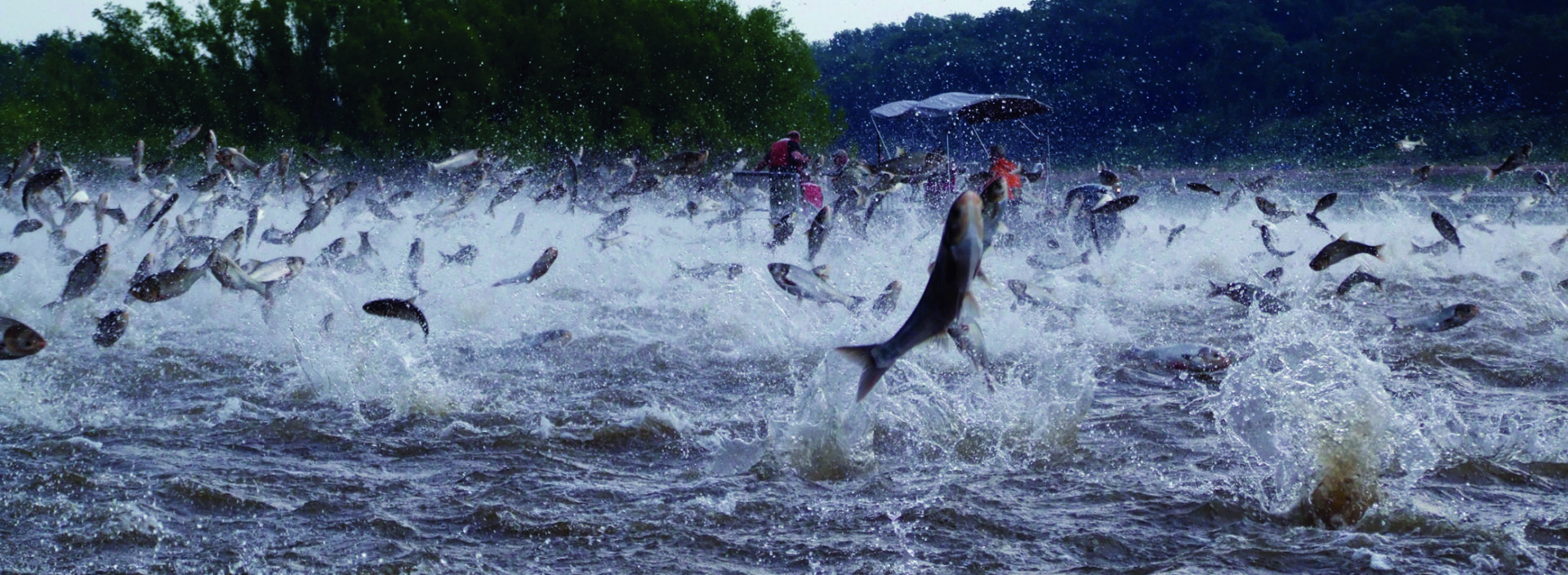
Jumping Carp
Asian carp in the Illinois River near Havana, Ill., jump in response to the noise of a motor or a charge from an electrofishing boat.
Read more...
|
|
|
A Message From the Director
Sea Grant Director Anders Andren talks up the program, including its work on aquatic invasive species.
Read more...
|
|
|
Part 1: All Washed Up, Lake Michigan's Algae Challenge
The first part of a longer-version video about the increased presence of Cladophora in Lake Michigan. What do invasive mussels have to do with it?
Read more...
|
|
|
Part 2: All Washed Up, Lake Michigan's Algae Challenge
The second part of a longer-version video about the increased presence of Cladophora in Lake Michigan. What do invasive mussels have to do with it?
Read more...
|
|
|
Quagga Mussels Feeding--Speeded Up 10x
Speeded up 10 times, this video emphasizes that quagga mussels are active animals--much more active than washed up shells on a beach would suggest.
Read more...
|
|
|
Who Are the Critters in Your Neighborhood?
Finding out who eats who in Lake Michigan -- and how two tiny water fleas could restructure the food web.
Read more...
|
|
|
Science Expeditions 2009
Experience science as discovery through a variety of "exploration stations," including an corral of AIS critters.
Read more...
|
|
|
Musseling into Lake Michigan
Zebra mussels make up the Sea Grant display at a public science event.
Read more...
|
|
 Research
|
Promoting the Stop Aquatic Hitchhikers! Campaign Throughout the Triathlon Community (Campbell)
The triathlon community has the potential to be a vector for aquatic invasive species (AIS). Wetsuits, which are commonly used during the swim portion of the event, have long been known to be a vector for AIS while swim course markings used by event organizers are often transported to multiple event sites, creating another potential vector for AIS. The sport is experiencing rapid growth and the potential for triathlon-mediated invasions is increasing. This project will educate triathletes and event organizers on the impacts of AIS, and what steps they can take to prevent the spread of AIS.
|
|
|
Great Lakes and Mississippi River Interbasin Study (Moy/Kline)
Conducted with the U.S. Army Corps of Engineers and the Sea Grant Great Lakes Network, this project will evaluate the impact of charter fishing on the Great Lakes and Mississippi River. Charter fishing business owners will receive written surveys in the spring of 2012, and Wisconsin Sea Grant will assist Ohio Sea Grant in presenting the results. This project is part of a larger effort to examine the economic impacts of establishing an ecological separation between the Great Lakes drainage basin and the Mississippi River drainage basin at the Chicago area waterway system.
|
|
|
Wisconsin Department of Natural Resources and Sea Grant Partnership for AIS Prevention (Moy)
This project, supported by the Wisconsin Department of Natural Resources (WDNR) with Great Lakes Restoration Initiative funds will support an aquatic invasive species (AIS) outreach coordinator to promote county- and municipal-level AIS prevention, control and education activities in Wisconsin’s Great Lakes’ drainage basins. Over the two-year project period, the outreach specialist will develop partnerships and increase awareness of WDNR AIS grants and other support to assist local AIS prevention efforts. In addition, the WDNR will provide GLRI funds to significantly expand the continuing AIS watercraft inspection project. This includes support for a coordinator and nine watercraft inspectors who will be stationed at Great Lakes boating access sites.
|
|
|
Fishing Tournament Organizers and Professional Anglers: Preventing the Spread of AIS by Extending AIS-HACCP and the Stop Aquatic Hitchhikers Campaign in the Great Lakes (Moy)
Most public information campaigns related to preventing the spread of aquatic invasive species (AIS) have been directed toward recreational boaters. However, recent unpublished research and anecdotal information suggests that fishing tournaments may serve to exacerbate the transport/colonization risk posed by zooplankton and disease organisms. This project will train professional anglers and tournament organizers in preventing the spread of AIS and produce brochures and booklets to help anglers become part of a broader citizen AIS monitoring network. Funding source: National Sea Grant Office. A/AS-64
|
|
|
A Comprehensive Regional Public Outreach Campaign on AIS (Moy)
Using an array of tools, Invasive Species Specialist Moy will work with Minnesota Sea Grant to coordinate the work of the Great Lakes Sea Grant programs and other external partners to educate students, sportsmen, recreational boaters and the general public about aquatic invasive species in both Lakes Michigan and Superior. Funding source: the Great Lakes Restoration Initiative. A/GLRI-3
|
|
|
Alteration of Nutrient Cycling and Food Web Structure by Profundal Quagga Mussels in Lake Michigan
Harvey Bootsma, UW-Milwaukee, (414) 382-1717, hbootsma@uwm.edu
Since the mid-1990s, quagga mussels have been displacing zebra mussels in Lake Michigan. Although the effects of zebra mussels in the nearshore zone have been well studied, the quagga mussel has spread into the profundal region, and there has been virtually no assessment of profundal mussels’ effects on nutrient cycling or food web dynamics in Lake Michigan. The objective in this Wisconsin-Illinois cooperative effort is to determine the role of the deepwater quagga mussel community in Lake Michigan’s energy flow pathways and nutrient cycling. The project’s main goals are 1) to quantify plankton consumption by the mussels,2) to quantify their phosphorus recycling,3) to assess the impact of mussels on food supply to higher trophic levels and 4) to implement a hydrodynamic/biogeochemical model, with the specific goal of simulating the water column response to C and P dynamics within the benthic boundary layer. R/HCE-02-10
|
|
|
Modeling the Interactive Effects of Dreissenid Invasion and Nutrient Loading on Autotrophic and Food Web Structure in Green Bay, Lake Michigan
M. Jake Vander Zanden, UW-Madison, (608) 262-9464, mjvanderzand@wisc.edu
The introduction of zebra and quagga mussels has had a dramatic economic and ecological impact on lake ecosystems due to their remarkable ability to change primary productivity. Most research has focused on the open-water system, but this new research project will examine the impacts of mussels on primary production in bottom- and open-waters across the variable nutrient-enriched gradient of Green Bay and study the impacts across the aquatic food web. The researcher will measure primary productivity across the trophic gradient of the mussel-invaded Green Bay; use productivity models to estimate the impact on primary productivity, including the nuisance alga Cladophora glomerata; examine how changes in nutrient and sediment loading will affect autotrophic structure; and use stable isotopes to examine the trophic pathways supporting fish. R/HCE-5
|
|
|
Linking Primary Production and Fish Along the Trophic Gradient in Green Bay, Lake Michigan
M. Jake Vander Zanden, UW-Madison, (608) 262-9464, mjvanderzand@wisc.edu
Lake productivity has long referred to the productivity of the pelagic, open-water zone, but recent work indicates that bottom habitats may also be important contributors. Additionally, the ongoing spread of Dreissenid mussels in North America generally increases the importance of benthic production and processes in lakes. In this project, researchers define lake autotrophic structureas the distribution of the overall primary production between benthic and pelagic habitats. They propose to quantify changes in autotrophic structure along Green Bay’s dramatic trophic gradient (ranging from hyper-eutrophic to oligotrophic) and use their field data to parameterize models estimating how changing Dreissenid grazing, nutrients and suspended sediments might be expected to affect autotrophic structure. They will also use stable carbon and nitrogen isotopes on contemporary fish and invertebrate samples, as well as archived scale samples, to test the hypothesis that the carbon sources underlying fish production track autotrophic structure across Green Bay’s trophic gradient. R/HCE-07
|
|
|
Dreissenid Impacts on Nearshore Carbon and Phosphorus Dynamics in Lake Michigan
Harvey Bootsma, UW-Milwaukee, (414) 382-1717, hbootsma@uwm.edu
The development of management goals and strategies for Lake Michigan relies on conceptual and numerical models that reliably simulate critical ecosystem processes. In the past decade, it has become apparent that these models require revision because of fundamental changes that have occurred in nutrient dynamics and energy flow. A number of these changes, including the decline of offshore plankton and invertebrate densities and the excessive growth of nuisance algae in the nearshore, have been attributed to the effects of filter-feeding Dreissenid mussels in the nearshore zone. Yet the mechanisms by which mussels influence energy and nutrient flow remain more conjectural than proven, leaving managers and policy makers without reliable models. This project will combine measurements of physical and biogeochemical processes in the Lake Michigan nearshore zone to quantify and model critical carbon and phosphorus fluxes, with an emphasis on the role of Dreissenids in mediating these fluxes. R/HCE-09
|
|
|
Interactions Between Dreissenid Mussels and River Sediment Plumes After Resuspension in the Coastal Area Around Sheboygan Harbor
Qian Liao, UW-Milwaukee, (414) 229-4228, liao@uwm.edu
The presence of invasive zebra and quagga mussels in coastal areas of the Great Lakes may have a fundamental effect on the transport and redistribution of contaminants among the sediments, water column and biota because mussels are capable of removing a large amount of suspended particulates through filter feeding. This project will evaluate the interactions between the mussels in the coastal water near the Sheboygan Harbor and the river plume resulting from resuspension due to physical forcing and human disturbance (during and after dredging). State-of-the-art field instruments will be deployed to quantify the transport and deposition of contaminated sediment plume after resuspension. The exchange rate of suspended sediment particles between the water column and the benthic community colonized by Dreissenid mussels will be measured and calculated. Data will be used to validate hydrodynamic-biogeochemical numerical models with the purpose of facilitating the assessment of ongoing and future remediation efforts. R/HCE-11
|
|
|
Changing Benthic Metabolism in the Great Lakes (FY13 Start)
Val Klump, UW-Milwaukee, (414) 382-1700, vklump@uwm.edu
The Great Lakes have experienced arguably the largest short-term ecological shift in their history within the last decade and face a long-term climate shift in the decades to come. The invasion of Dreissenid mussels, the disappearance of Diporeia, and the predicted increasing temperatures and lengthening stratification have altered and will alter the role of benthic metabolism. The nearshore habitat is a complex of newly colonized cobble, gravel, hard clay and silty sands. Deepwater bottoms have been overrun with mussels. Production and respiration of oxygenare notoriously difficult to measure in such environments since many of the common methods — oxygen and pore water gradients, sediment or chamber incubations — all have limitations. The researchers propose to employ new, nondisruptive eddy correlation techniques to study oxygen exchange at the benthic boundary in a range of Great Lakes environments that have undergone or will undergo significant change. R/HCE-12
|
|
|
Climate Change Increases Sea Lamprey Impact in Lake Superior
James Kitchell, UW–Madison, (608) 262-7259, kitchell@wisc.edu
The average summer surface water temperature of Lake Superior has increased by about 3.5°C over the past three decades. Warmer water temperatures have increased the duration of thermal stratification and lengthened the period of lake trout’s preferred thermal habitat (9-11°C) by up to twofold. Because lake trout are the preferred host of sea lamprey, changes to their thermal habitats alter the feeding and growth of sea lamprey, among the greatest threats to Lake Superior fisheries. While control efforts have been tremendously successful at reducing lamprey abundance, climate change raises questions about how increasing water temperatures in Lake Superior will change the parasitic behavior of remaining lamprey. This project will develop bioenergetic models that estimate effects of climate warming on sea lamprey growth in multiple regions of Lake Superior. Combining these results with information about host abundance and stable isotope-based estimates of lamprey diet in Lake Superior, the project will determine how increased lamprey growth may influence mortality of native lake trout. R/SFA-2
|
|
 Related Websites
|
Video on AIS
Check out video on Asian Carp and on zebra mussels.
Read more...
|
|
|
|
|
Wisconsin's Water Library
Wisconsin's Water Library has reading lists on many different topics. Take a look at the aquatic invasive species reading list.
Read more...
|
|
 Related Topics in this Site
|