

The case of the dead sturgeon
Photography by Bonnie Willison
As Wisconsin Sea Grant’s fisheries specialist, Titus Seilheimer is unfazed by dead fish. He’s seen them on plates, over ice, in dissection pans, and belly-up in the backwaters of countless rivers and lakes. Strangers seek him out for his skill at identifying the dead.
“I get so many pictures of fish. That’s kind of what my role is now,” he joked.
But in late March, he encountered a dead fish that gave him pause.
Seilheimer was conducting field work at University Beach along the University of Wisconsin–Green Bay Manitowoc campus when a couple approached him. They talked about fluctuating Lake Michigan water levels, and before resuming their walk, alerted him to a dead lake sturgeon further down the beach.
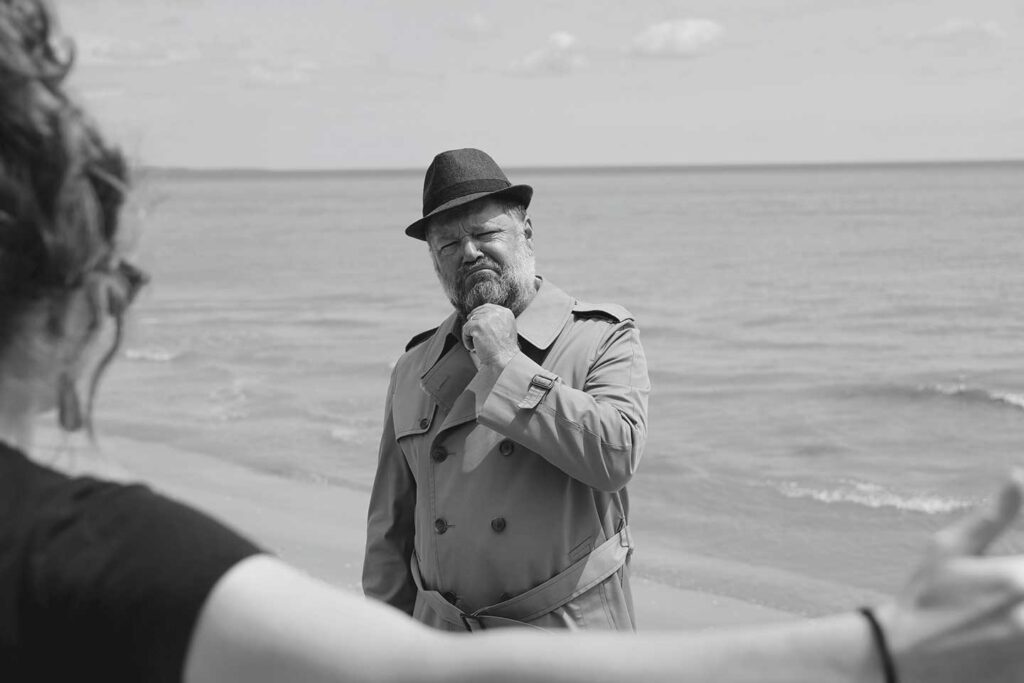
They extended their arms wide.

It was big.
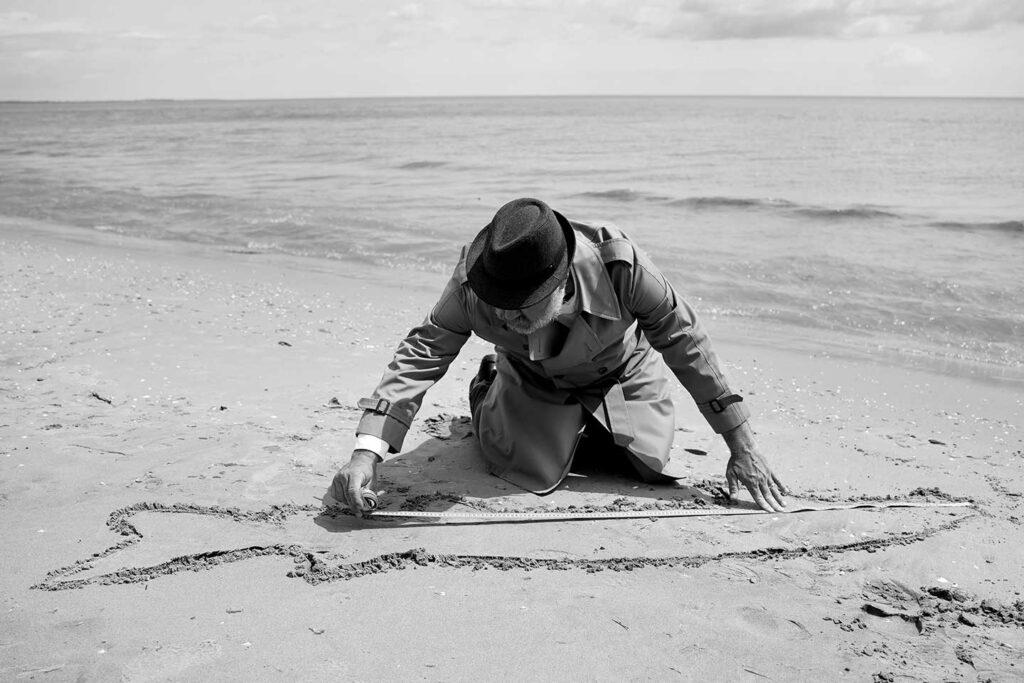
This big.
They extended their arms wide. It was big. This big.
Seilheimer was skeptical. “In my head I was like, yeah, okay,” he said. Over the years he had witnessed people’s tendency to misidentify fish as rare or otherwise appealing species. A common carp rotting on the beach was decidedly less interesting than a sturgeon, bereft of life, spat upon the strand from the depths of Lake Michigan.
Seilheimer also knew that it was statistically unlikely to find one on a Manitowoc beach. While a healthy population exists in Lake Winnebago, sturgeon are less common in the Great Lakes due to historic overharvesting, dams, and pollution. Seeing them spawn in the Peshtigo and Fox Rivers is usually the closest one gets in Lake Michigan.
Yet, the couple was right.
“Sure enough, it was a four-and-a-half-foot-long sturgeon dead on the beach,” said Seilheimer. The carcass was gray and weathered, and the fish no longer had eyes or gills. It looked like both a torpedo and a dinosaur.

Seilheimer snapped a few photos before returning to his work. The fish, however, continued to linger in his mind throughout the day. Who was this fish? Where did it come from? And importantly, how did it die?
For the average person, such questions often remain unanswered.
Seilheimer, of course, isn’t an average person — he’s a fisheries specialist, a man with a particular set of skills and connections.
He decided to investigate.
Seeing into the lives of fish
Like many animals, fish conduct their lives outside the human gaze. Their days unfold underwater and across great distances in ways difficult to observe by either eye or machine. Scientists, however, have tools to help them steal glimpses.
Seilheimer wasn’t pondering instrumentation, though, as he drove home from work. He thought about sturgeon. His mind shuffled through memories of releasing baby sturgeon with his kids into the Kewaunee and Milwaukee Rivers, events that were part of a larger effort to reestablish the fish in Lake Michigan’s tributaries. The young sturgeon would make their way to Lake Michigan
and hopefully, if they survived, return to the river many years later to spawn.
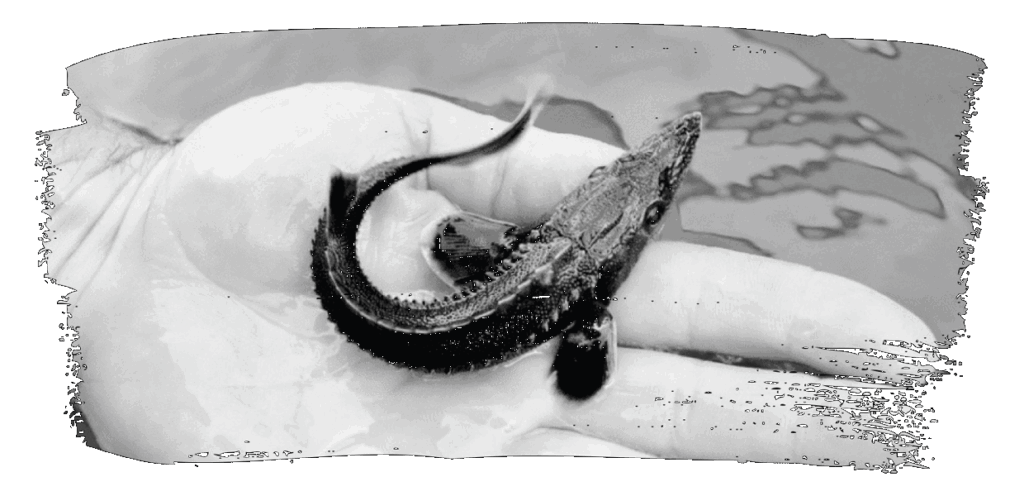
As he replayed the scene in his head, Seilheimer remembered he and his kids received certificates with numbers on them. Numbers to identify the specific fish they released. Numbers to track the
fish over time. Numbers under their skin.
The idea, like a distant barge, slowly came into focus.
“It finally all connected. It took hours, but it finally came into my brain,” said Seilheimer. “The sturgeon could have a PIT tag.”
Passive integrated transponder (PIT) tags are battery-free, rice-sized microchips that scientists use to track the movement, migration, and survival rates of fish. Similar to the microchips used on pets, PIT tags are inserted under the skin and contain a unique string of numbers that are read by a scanner.
They can also last for the lifetime of the fish. That’s a boon for tracking sturgeon, whose lifespans mirror that of humans.
Finding a tag in this sturgeon would help Seilheimer answer the question of who this fish was and where it came from. It would be a promising lead. He had just one problem though: a lack of hardware. He didn’t have a PIT-tag reader.
But, like a good outreach specialist, he did have friends.
Sturgeon 989.001030780371
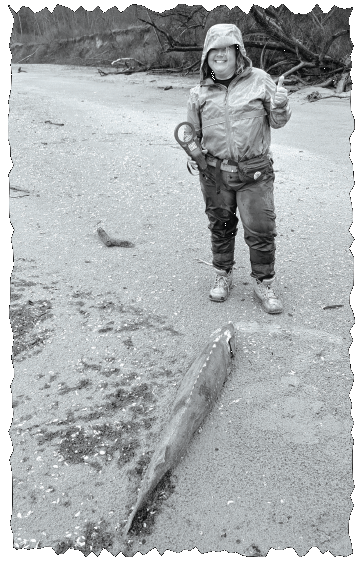
When Seilheimer returned to the beach the following day, he wasn’t alone. Accompanying him to the scene of the crime was Karen Murchie, the director of freshwater research at the Shedd Aquarium, holding what looked like a bright green remote control.
It was a PIT-tag reader, and for a fisheries specialist, it was (almost) better than a suitcase of money. Seilheimer knew Murchie would be in the area that day to install a white sucker monitoring station on nearby Silver Creek and asked if she could bring the reader.
“It was great timing,” said Seilheimer. “Just bizarre timing.”
Back at the beach, another stroke of luck: the sturgeon was still there. A coyote hadn’t hauled it off during the night, nor had the waters of Lake Michigan risen to reclaim it. The fish was right where it had been yesterday, patiently waiting in the damp, pitted sand.
Seilheimer watched as Murchie waved the PIT-tag reader over the sturgeon. He knew the story could end here, that the serendipitous string of events that led him to the fish on the beach could hit a dead end.
But the reader beeped. Murchie held up the screen for Seilheimer to see. The sturgeon
was anonymous no more.
Hello, 989.001030780371.
The successful return of sturgeon
Equipped with a number, Seilheimer reached out to another colleague, Aaron Schiller, a fisheries biologist and sturgeon expert at the Wisconsin Department of Natural Resources.
The WDNR has led sturgeon rehabilitation efforts in Lake Michigan since 2003, when it began releasing baby sturgeon in the Milwaukee River — the same program Seilheimer participated in with his kids. The agency maintains a database of the tagged fish so scientists can track where the fish move, how they develop, and if they survive.
Schiller ran the number. The dossier was thin but illuminating.
“We know three things,” said Seilheimer.
The sturgeon was captured and PIT-tagged in the Milwaukee River in 2022.
At the time, it was 56 inches.
The sturgeon’s right ventral fin was clipped.
With these facts, Seilheimer deduced a couple details about the sturgeon’s life.
First, the fish came from the Milwaukee River rehabilitation efforts. All baby sturgeon released
into the river have their left or right ventral fin clipped to indicate that they were stocked.
And second, the sturgeon could be as old as 23. The WDNR began stocking in 2003, and at 4.5 feet, this sturgeon could have feasibly been released at that time. Given the fish’s size, it was at least in its upper teens.
But why wasn’t this fish PIT-tagged when it was released as a baby like the others? Schiller said that the young sturgeon released through the program often lose their tags as they age. The fact that it didn’t have one when it was captured in 2022 wasn’t unusual.
As broad strokes of this sturgeon’s life began to emerge, Seilheimer realized his sleuthing couldn’t answer one big question: how the fish died. At that size, the sturgeon didn’t have predators. It could have been sick, injured, or eaten something it shouldn’t have.
Science, unlike Hollywood, makes no promises of grand reveals or tidy conclusions, and Seilheimer would have to live with the mystery.
So instead he thought about how the sturgeon may have lived.
“It’s interesting to imagine the life of this fish that has been swimming around for a long time and grown to this size,” he said. “You know, I’m hoping it had the best possible life.”
And there are many organizations, including Wisconsin Sea Grant, that work together to ensure sturgeon continue to have better lives and flourish in the Great Lakes. Over the years, Wisconsin
Sea Grant has funded research on how to best raise and feed sturgeon for stocking, contributed to two books, and educated kids and adults about the efforts to bring them back to the Great Lakes.
The fact that this sturgeon survived as long as it did and returned to the Milwaukee River is a testament to the success of those efforts.
So how does Seilheimer feel, continuing this legacy of connecting people, resources, and curiosity to support such a beloved fish?
He tipped his proverbial hat. “It is just another day at the office,” he said.
Thank you to our photoshoot locations—the Wisconsin Maritime Museum and the UW-Green Bay Manitowoc Campus.

The UW–Madison Aquatic Sciences Center administers Wisconsin Sea Grant, the Wisconsin Water Resources Institute, and Water@UW–Madison. The center supports multidisciplinary research, education, and outreach for the protection and sustainable use of Wisconsin’s water resources. Wisconsin Sea Grant is one of 34 Sea Grant programs supported by the National Oceanic and Atmospheric Administration in coastal and Great Lakes states that encourage the wise stewardship of marine resources through research, education, outreach, and technology transfer.