
New book club explores the mysteries of Great Lakes shipwrecks
This fall, the Wisconsin Water Library and the Wisconsin Historical Society are teaming up to launch an online book club focused on Great Lakes shipwrecks and maritime history. The Dive into History book club will feature books from regional authors as well as presentations from maritime archaeologists who document the wrecks and reconstruct their histories.
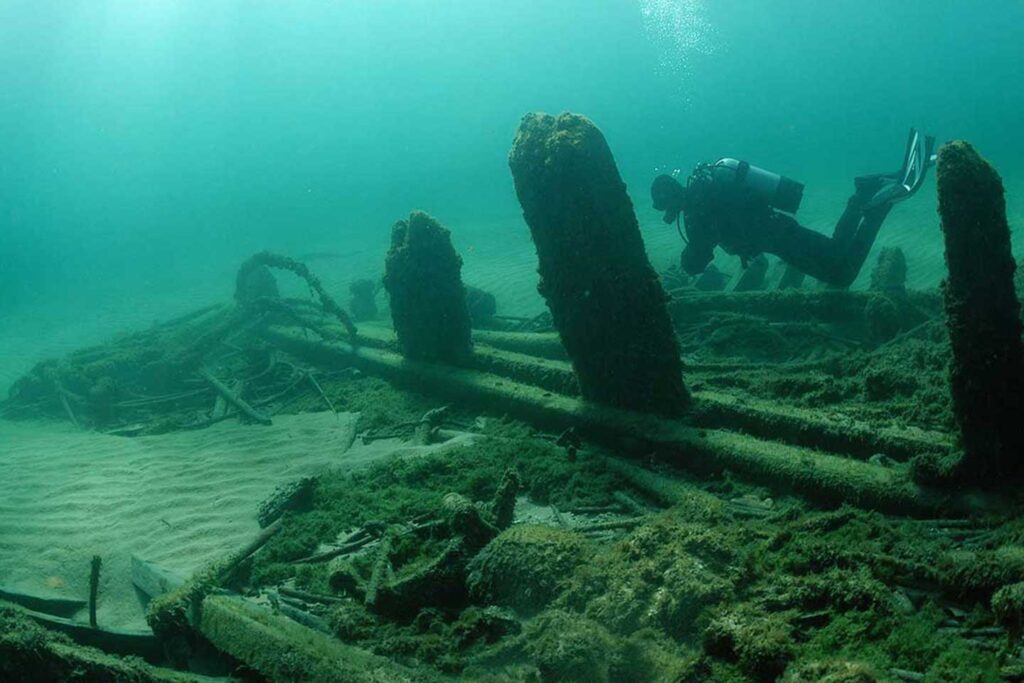
Kendra Kennedy, a maritime archaeologist with the Wisconsin Historical Society, will kick things off on October 7 at 7 p.m. CT with a discussion of Great Lakes maritime history. On November 4, the club will discuss its inaugural pick, “Wrecked: The Edmund Fitzgerald and the Sinking of the American Economy” by Tom Nelson and Jerald Podair.
“Our first book choice is about arguably the most well-known wreck in Great Lakes history,” said Anne Moser, Wisconsin Sea Grant’s education coordinator and librarian. “And this book is a great opportunity to dive deeper into that story.”
Moser got the idea for a shipwreck-themed book club for adults after seeing how much kids loved learning about the topic.
“No matter your age, shipwrecks just capture the imagination,” she said. “The stories offer another way to learn about and appreciate the Great Lakes, especially if you don’t see yourself as a science person.”
Risa Stiegler, library assistant and University of Wisconsin–Madison graduate student, will be co-facilitating the book club with Moser. She said part of the curiosity around shipwreck stories is that many of them are mysteries.
“If a ship disappears with all hands, then it’s a mystery what happened to it, and people have to reconstruct the evidence,” she said.
Alternatively, if some crew members survive, their understanding of what happened may not be the same. “We get these fragmented accounts from different people with different experiences of it. Those are kind of like the elements of a detective story,” Stiegler said.
Kennedy is one of those detectives. At the October 7 meeting, she’ll be discussing the maritime history of Wisconsin and how Great Lakes shipping fueled the development of the Midwest.
Shipwrecks, she said, are a window into both regional and personal history.
“You can look out at the lakes, and so often it seems empty, right?” said Kennedy. “But there’s so much going on above and below the surface, and this is a chance to get familiar with how the Great Lakes have impacted either your life or the lives of your ancestors or just your region in general.”
Sign up for the book club on the Wisconsin Water Library website.
The UW–Madison Aquatic Sciences Center administers Wisconsin Sea Grant, the Wisconsin Water Resources Institute, and Water@UW–Madison. The center supports multidisciplinary research, education, and outreach for the protection and sustainable use of Wisconsin’s water resources. Wisconsin Sea Grant is one of 34 Sea Grant programs supported by the National Oceanic and Atmospheric Administration in coastal and Great Lakes states that encourage the wise stewardship of marine resources through research, education, outreach, and technology transfer.