
Water decontamination
Water decontamination can help prevent the spread of AIS. Watercraft decontamination is considered any steps in addition to a visual inspection and draining water. Ways to carry out watercraft decontamination include drying, a decontamination unit, pressure washing or chemical solutions.
When should you consider decontamination?
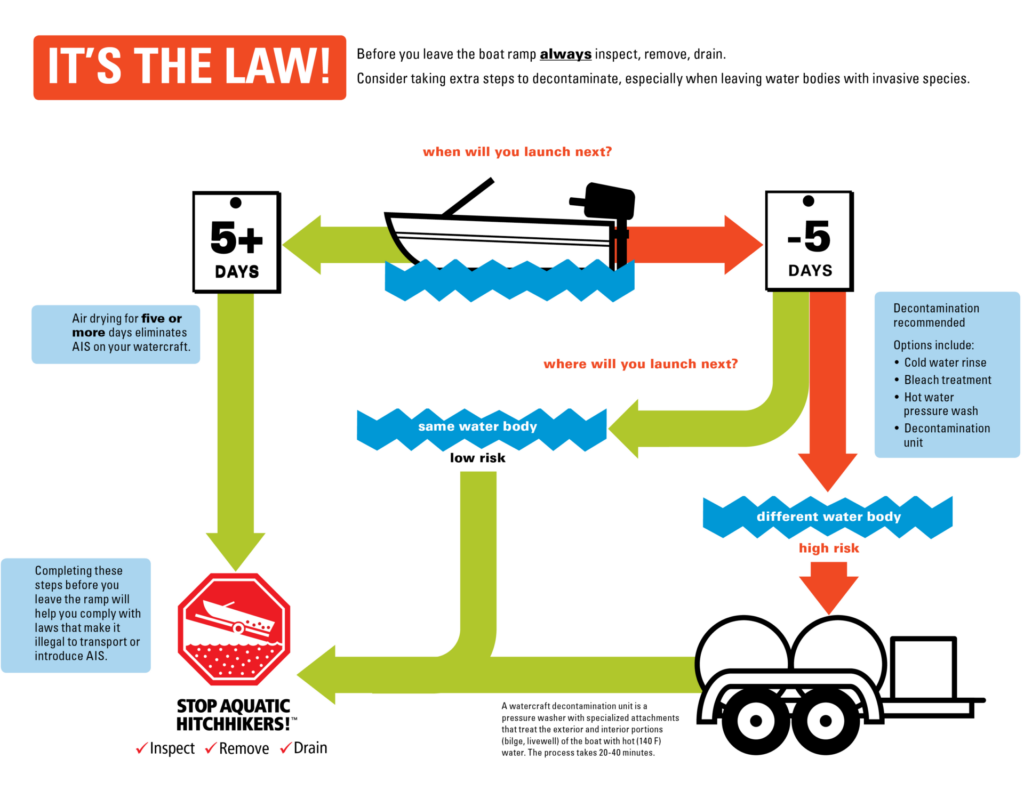
- If your watercraft will be out of water for six or more days, the watercraft is considered decontaminated.
- If you always boat on the same body of water, extra decontamination steps are not essential.
- Watercraft that are used on different water bodies without six days in between should consider decontamination.
- Altering boating behavior by only using one water body can reduce the risk of transferring AIS.
- If visiting multiple water bodies in a day, visit the uninvaded sites followed by the invaded sites.
Further details are:
Boaters that launch six or more days apart are at a low risk for moving AIS, and the extra decontamination efforts are not necessary. The same goes for boaters that always use the same body of water; if they aren’t changing water bodies, they will not be moving AIS. However, boaters utilize multiple bodies of water and launch within six days of their last launch are at higher risk of transporting AIS, thus extra decontamination efforts would greatly reduce their probability of introducing new AIS to a water body.
In addition to extra decontamination steps, boaters can alter their boating behavior in order to reduce their risk of moving AIS. Boating on a single body of water is one the probability of moving organisms. If a boater needs to visit multiple water bodies in a single day, if possible the trip should visit uninvaded water bodies first. This also reduces the risk of moving AIS as the boat will be launched in few water bodies after potentially being contaminated with AIS. Of course, boaters will always need to clean and drain – remove any aquatic vegetation from their watercraft and trailers, and drain any water from their livewell and bilge – in order to be in compliance with Wisconsin Department of Natural Resources boating regulations.
In an ideal world, all boaters would take extra decontamination efforts when drying their watercraft for six or more days is not possible. This Clean Boat Guide Decontamination Flow Chart below will help boaters understand when that extra effort will better help protect Wisconsin’s waters from further invasions.
Legal guidance
As interest in watercraft inspection and decontamination (WID) grows, there is an increased risk that someone might be injured or a boat damaged during the decontamination process. This can raise concerns that the person or organization performing the decontamination could be held liable for any injury or damage that occurs. Download Wisconsin WID Liability Fact Sheet
Decontamination protocols
Clean, Drain, Dry
While “Clean Drain Dry” is an effective method for reducing the risk of transporting AIS, sometimes drying the recommend 6+ days is not an option. Below are protocols for watercraft decontamination options that help reduce the risk of transporting AIS when drying is not practical.
Stop Aquatic Hitchhikers
One of the reasons the Stop Aquatic Hitchhikers! campaign has been so successful is because of its simple guidance. Almost anyone can clean, drain and then dry their watercraft, and these prevention activities have proven to be one of the most effective methods of reducing the risk of transporting AIS. Visual inspections are very effective at removing aquatic vegetation, while the drying is effective at killing the microscopic organisms left behind by the visual inspection.
Watercraft Decontamination
Unfortunately, drying watercraft for six or more days is not always a feasible option for boaters. In these cases, additional watercraft decontamination steps are encouraged to reduce the risk of spreading AIS. Watercraft decontamination is the process of removing organisms and parts of organisms (e.g. plant fragments, eggs) from the watercraft and trailer. This process, in addition to “Clean Drain Dry,” greatly reduces the risk of transporting AIS. Decontamination can be accomplished different ways with varying advantages and disadvantages.
Drying
- Advantage: Little effort, free, self
- Disadvantage: 6+ days for decon.
Chemical Solution (Bleach, vinegar)
- Advantage: Quick, inexpensive, self
- Disadvantage: May not treat interior tanks and lines
Hot Water Pressure Wash
- Advantage: No chemicals, quicker than decon unit, self
- Disadvantage: May not treat interior tanks & lines, lines to use unit
Decon. Unit
- Advantage: Complete decon. in 20-30 min
- Disadvantage: Trained applicator needed, cost, time, lines to use unit